

You told your employer that you needed time away from work because of your own medical condition, to care for a family member, or to bond with a new child. Then you heard something you were not expecting: your job is not protected.
Maybe your employer told you the company is too small. Maybe you have not worked there long enough. You may already be receiving New Jersey Temporary Disability Insurance or Family Leave Insurance benefits and assumed that meant you could return to your position when your leave ended.
Before July 17, 2026, receiving TDI or FLI benefits did not itself provide the separate job protection that New Jersey law now provides to qualifying workers. Under the new law, employees receiving TDI or FLI benefits through the state or an approved private plan have job protection during qualifying unpaid leave when that leave is not already covered by the NJFLA or federal FMLA.
If your employer is telling you that you can be replaced, fired, or denied your position because you took leave, whether that is legally correct depends on why you are out of work, which benefits you are receiving, and which job-protection laws apply to your absence.
Does New Jersey’s New 2026 Leave Law Protect Your Job?
New Jersey expanded job protection in two important ways on July 17, 2026, and both changes can affect whether you have the right to return to your job after taking qualifying leave.
More employees now qualify for protection under the New Jersey Family Leave Act, or NJFLA. As of July 17, 2026, the NJFLA generally applies to private employers with at least 15 employees worldwide, down from the previous 30-employee threshold, as well as state and local government agencies regardless of size.
An employee generally becomes eligible after working for the employer for at least three months and at least 250 hours during the previous 12 months. Before July 17, the requirements were 12 months and 1,000 hours.
Eligible employees can still take up to 12 weeks of job-protected NJFLA leave during a 24-month period to bond with a new child or care for a family member with a serious health condition.
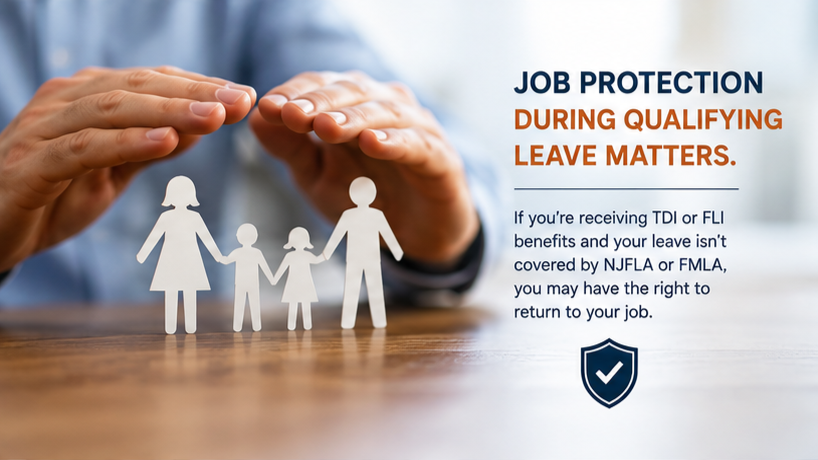
The second change reaches workers who are not otherwise protected by NJFLA or the federal Family and Medical Leave Act. If you receive New Jersey Temporary Disability Insurance, known as TDI, or Family Leave Insurance, known as FLI, through the state or an approved private plan, your leave can now carry a separate right to job protection when the leave is not already covered by NJFLA or FMLA.
That distinction is particularly important for employees who previously fell outside traditional leave-protection requirements.
What If You Work for a Small Company or Recently Started Your Job?
Before assuming that your job is unprotected, it is important to identify which law applies.
The expanded TDI and FLI job protection does not have a minimum employer-size requirement or a minimum period that you must have worked for your current employer. Eligibility for TDI and FLI benefits is based on recent earnings rather than how long you have held that particular job.
That means an employee who works for a business with fewer than 15 employees or who recently started a new job can still have job-protection rights during a period of unpaid leave while receiving qualifying TDI or FLI benefits, even if NJFLA or FMLA does not protect that period of leave.
This is one reason an employer’s statement that “you haven’t worked here long enough” or “we are too small for family leave” does not necessarily end the analysis.
The question is not simply whether you qualify under one leave law. It is which protections apply to your specific absence.
Does the New Law Protect Leave for Your Own Medical Condition?
This is where the different New Jersey leave programs can become confusing.
NJFLA provides qualifying employees with leave to care for certain family members with serious health conditions and to bond with a new child. It does not provide NJFLA leave for an employee’s own disability or medical condition. Federal FMLA can protect an eligible employee taking leave for their own serious health condition, but the federal eligibility requirements remain unchanged.
The July 2026 change creates an important additional protection.
If you are receiving qualifying TDI benefits for your own health condition during a period of unpaid leave and that leave is not otherwise protected by federal FMLA, New Jersey’s TDI/FLI law provides a separate right to job protection when the new law’s requirements are met.
For example, this can matter if you need time away from work while recovering from an illness, surgery, non-work-related injury, pregnancy-related disability, or another qualifying health condition but do not meet the federal FMLA requirements.
The fact that one leave law does not apply therefore does not necessarily mean your employer is free to terminate your employment.
Can Your Employer Refuse to Give You Your Job Back After Protected Leave?
When the new TDI or FLI job protection applies, New Jersey guidance states that you have the right to return to the same job or a position with the same pay, benefits, seniority, and other terms of employment.
That makes what happens during and after your leave important.
Suppose your employer tells you that your position was filled permanently while you were out. You return and discover that your hours have been reduced substantially. Your previous responsibilities have been reassigned, your pay has changed, or you are told there is no position available for you.
Those facts should not be evaluated in isolation.
New Jersey also prohibits retaliation connected with seeking or taking qualifying TDI or FLI benefits. State guidance identifies actions such as firing an employee, threatening the employee, or cutting hours as examples of adverse treatment that can raise retaliation concerns.
Not every workplace change following leave proves a legal violation. What matters is what protection applied to your leave, what the employer did, why it acted, and how the circumstances fit together.
What Should You Review If Your Employer Says Your Leave Is Not Protected?
A disagreement over leave rights often turns on details that can be reconstructed from documents, dates, and communications.
At Rudnick, Addonizio, Pappa & Casazza PC, when we evaluate an employment-law concern involving medical or family leave, we look at the entire sequence rather than relying solely on the explanation an employee was given.
Relevant information can include:
- Why you needed the leave
- When the leave began and ended
- When you notified your employer
- Whether you applied for or received TDI or FLI benefits
- Whether those benefits came through the state or an approved private plan
- How long you worked for the employer and the hours you worked
- The employer’s size
- Notices, emails, text messages, or letters concerning your leave
- What your employer told you about returning to work
- Any termination, reduction in hours, reassignment, loss of benefits, or other change that followed the leave
For an employee whose leave is not already protected by NJFLA or FMLA, New Jersey currently instructs employers to assume that an employee who has applied for TDI or FLI benefits will qualify and to protect the employee’s job while the application is pending unless a determination establishes otherwise.
Preserving the communications surrounding your leave can therefore help establish what everyone knew and when decisions about your employment were made.
What If Your Employer Says You Do Not Qualify for FMLA?
Being told that you do not qualify for federal FMLA does not automatically mean your job is unprotected.
FMLA, NJFLA, and New Jersey’s TDI/FLI job protection have different eligibility rules and cover different circumstances. Federal FMLA did not change when New Jersey’s new provisions took effect. NJFLA now covers more employers and employees, while the new TDI/FLI protection reaches qualifying workers whose leave is not otherwise protected under NJFLA or FMLA.
That means an employer’s conclusion that you are ineligible for FMLA answers only one part of the question. You still need to determine which other protections may apply, including whether you qualify for NJFLA or whether receiving qualifying TDI or FLI benefits gives you separate job protection under New Jersey law.
If you are unsure which law covered your absence, the reason for your leave, your employment history, the benefits you received, and the dates involved can help determine which protections applied.
Told Your Job Is Gone After Taking Leave in NJ? Understand Your Legal Options
Taking time away from work because you are sick, recovering from a medical condition, caring for someone you love, or welcoming a child can already create financial and personal pressure. Learning that your employer does not intend to give you your job back can add another problem at exactly the wrong time.
New Jersey’s July 2026 changes expanded job-protected leave for many employees who previously could have fallen outside traditional protections. Whether those changes apply to you depends on the reason for your leave, the benefits you received, and the circumstances surrounding your employment.
At Rudnick, Addonizio, Pappa & Casazza PC, we represent employees facing workplace disputes throughout New Jersey, including workers in Monmouth, Middlesex, and Ocean Counties. We can review the circumstances surrounding your leave, identify the state or federal protections that apply, and explain your legal options if your employer refused to return you to your job or took action against you for seeking or taking protected leave.
If your employer says your job was not protected, that statement does not necessarily resolve the issue. Contact us to discuss what happened and how New Jersey’s current leave laws apply to your circumstances.
Disclaimer: Results may vary depending on your particular facts and legal circumstances. The articles on this blog are for informational purposes only and are no substitute for legal advice or an attorney-client relationship. If you are seeking legal advice, please contact our law firm directly.