


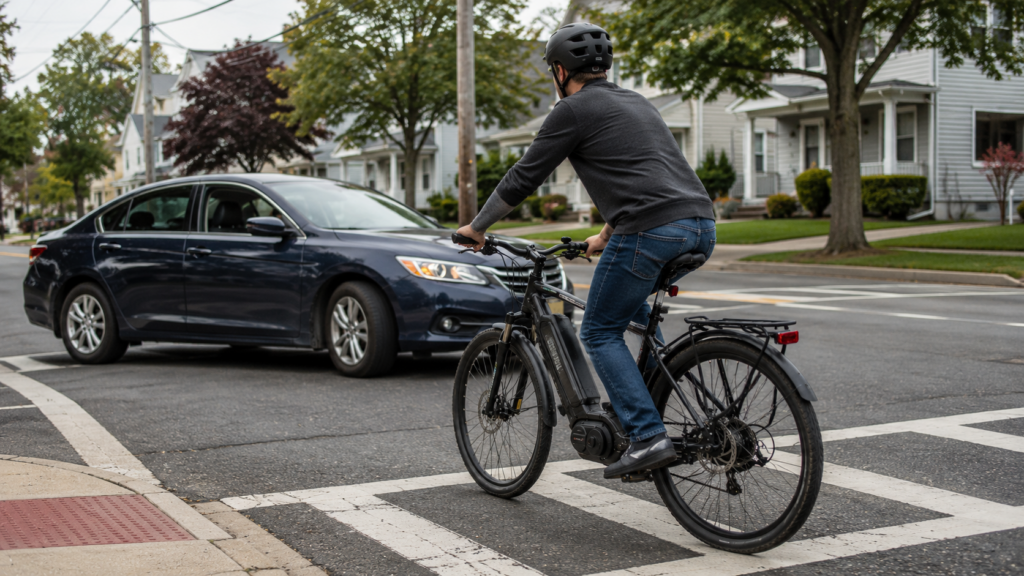
You were riding an e-bike when a driver turned across your path, entered the intersection in front of you, or struck you from behind. Now you are dealing with injuries, medical treatment, and an insurance claim.
But another question has entered the conversation: was your e-bike properly classified and registered, and did you have any license or permit New Jersey required for that type of bicycle?
Those questions matter because New Jersey changed its e-bike laws in 2026.
Riders now face licensing and registration requirements that did not previously apply to many e-bikes, and different rules can apply depending on the type of electric bicycle involved.
If you were injured because of another driver’s actions, however, a registration, licensing, or permit issue does not answer the larger question of who caused the crash. Understanding how the new rules fit into an injury claim requires looking at the e-bike, how each person was traveling, and what actually led to the collision.
What Changed for New Jersey E-Bike Riders in 2026?
New Jersey’s new e-bike law expanded the licensing and registration requirements that apply to low-speed electric bicycles and motorized bicycles.
Under current New Jersey Motor Vehicle Commission guidance, a low-speed electric bicycle is generally a two-wheeled, pedal-assisted bicycle whose motor provides assistance only while the rider is pedaling and stops assisting at 20 mph. The motorized-bicycle category is broader and can include bicycles with electric pedal assist or throttle capability, depending on how the motor operates and the speed the bicycle can reach under power.
New Jersey law also separately defines an “electric motorized bicycle” based on several features, including two wheels, usable pedals, an electric motor rated above 750 watts, and the ability to travel at speeds greater than 28 mph. The law includes those vehicles within its definition of a motorcycle, rather than treating them as low-speed electric bicycles or motorized bicycles. That is another reason the specifications of the bicycle can matter after a crash.
Insurance also depends on classification. Under the rules applicable to low-speed electric bicycles and motorized bicycles, motorized bicycles require insurance, while low-speed electric bicycles do not.
As of August 2026, a person generally must be at least 15 years old to operate a low-speed electric bicycle or motorized bicycle in New Jersey. Riders age 17 or older generally must have a valid driver’s license or a valid motorized-bicycle license or permit, while riders who are 15 or 16 generally must have a motorized-bicycle license or permit. Low-speed electric bicycles and motorized bicycles also must be registered with the MVC.
A limited exception to the licensing requirement applies to certain riders age 16 or older renting shared low-speed electric bicycles from a company operating under contract with a local government.
The date of the ride can matter too. The law was enacted on January 19, 2026, and gave people six months to obtain newly required licensing, registration, or insurance that had not previously been required.
That six-month transition period expired on July 19, 2026.
These distinctions can become important after a collision because the appearance of the bike alone does not necessarily establish which rules applied. Its motor, throttle, pedal-assist system, maximum assisted speed, and whether it was part of a shared rental program can affect the analysis.
Does Breaking an E-Bike Rule Mean You Cannot Bring an Injury Claim?
No single registration or licensing issue automatically decides who was responsible for a collision.
Suppose a driver makes a left turn across an e-bike rider’s path without enough room to complete the turn safely. The fact that the rider’s e-bike was not properly registered does not, by itself, explain why the vehicles collided.
The same principle applies if a rider did not have the required license or permit. That fact can be relevant to the overall circumstances, but the injury claim still requires an examination of how the crash occurred and whether the conduct of the driver, the rider, or both contributed to it.
A violation of a New Jersey traffic law can be relevant to a negligence analysis when it is connected to how the collision occurred, but the violation does not automatically establish responsibility for the crash.
That distinction is especially important under the new e-bike framework. An insurance company may focus on the rider’s compliance with registration, licensing, or operating requirements. The response should not stop there. The events immediately before impact still matter.
Why the Type of E-Bike Matters After a Crash
Many riders simply refer to what they own as an “e-bike.” New Jersey law is more specific, and the correct classification can affect which licensing, registration, insurance, and operating rules apply.
For that reason, identifying the bicycle itself can become part of the investigation.
Useful information can include the make and model, manufacturer’s specifications, motor rating, top assisted speed, whether the bike uses a throttle, the label affixed by the manufacturer, and whether the bicycle was modified after purchase.
New Jersey law requires manufacturers and distributors of low-speed electric bicycles to affix a label identifying the bicycle’s classification number, top assisted speed, and motor wattage. Photographs of that label, the bike itself, and the manufacturer’s specifications can therefore provide useful information when determining how the bicycle should be classified, rather than relying solely on how it was described in a police report.
What Evidence Can Show How an E-Bike Collision Happened?
Once the applicable rules are identified, the focus returns to the collision itself.
At Rudnick, Addonizio, Pappa & Casazza PC, when we review an injury involving an e-bike and another vehicle, we look at the circumstances leading up to the impact rather than treating the bike’s regulatory status as the entire case.
Depending on what happened, relevant evidence can include:
- Photographs of the e-bike, vehicle, roadway, and point of impact
- Surveillance, dashcam, doorbell, or traffic-camera footage
- Statements made by the driver or rider
- Witness accounts
- The police crash report
- Damage to the bicycle and vehicle
- The e-bike’s make, model, motor, and operating specifications
- Registration or insurance information when applicable
- Road signs, traffic signals, and lane markings
- Medical records documenting the injuries and treatment following the collision
The timing of that evidence can matter. Video can be overwritten, physical damage can be repaired, and witnesses can become harder to locate. Preserving what exists shortly after the crash can help establish how each person was moving before the impact.
What If the Driver Says You Were Partly Responsible?
An e-bike crash does not have to be entirely one person’s fault.
A driver might argue that the rider entered an intersection too quickly, failed to obey a traffic signal, was traveling somewhere the bike was not permitted, or otherwise contributed to the collision. A rider may contend that the driver failed to yield, followed too closely, opened a vehicle door into the rider’s path, or turned without accounting for the bicycle.
New Jersey follows a modified comparative-negligence rule. An injured person’s own negligence does not automatically prevent recovery when it is not greater than the negligence of the party, or combined parties, from whom damages are sought. Any damages awarded are reduced by the percentage of responsibility attributed to the injured person.
That means questions about the rider’s conduct should be evaluated in relation to the crash itself.
For example, whether the rider had the proper registration and whether the driver failed to yield are different questions. Both can be investigated, but they do not necessarily carry the same significance when determining what caused the collision.
Injured in a New Jersey E-Bike Crash? Start With What Actually Happened
The new rules give insurance companies and injured riders additional questions to address after an e-bike collision. Was the bicycle registered? Did the rider have the required license or permit at the time of the crash? How was the bike classified? Had the 2026 transition period expired? Was insurance required?
Those questions are important, but they should not overshadow the central issue in an injury claim: what caused the crash and how did each person’s actions contribute to it?
For riders throughout New Jersey, including Monmouth, Middlesex, and Ocean Counties, that can mean looking closely at the roadway, the driver’s actions, the e-bike itself, available video, witness accounts, and the sequence of events immediately before the collision.
At Rudnick, Addonizio, Pappa & Casazza PC, we represent people injured in motor vehicle and bicycle-related accidents. We can review how the collision occurred, determine which New Jersey e-bike rules applied, evaluate the available evidence, and explain how those facts can affect your legal options.
If you were injured while riding an e-bike and have questions about what the new 2026 rules mean for your claim, contact us to discuss the circumstances of the crash.
Disclaimer: Results may vary depending on your particular facts and legal circumstances. The articles on this blog are for informational purposes only and are no substitute for legal advice or an attorney-client relationship. If you are seeking legal advice, please contact our law firm directly.